Canadian delegation gets a behind-the-scenes look at BPRC
A Canadian delegation from Université Laval visits BPRC to exchange knowledge and experiences ahead of the establishment of a new primate research centre.
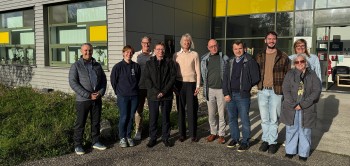
How do you build a research centre that is prepared for future pandemics? With this question in mind, a delegation from Canada's Université Laval visited BPRC. The university is working to establish the National Primate Center for Pandemic Prevention (NPCPP), which will include its own breeding colony, specialised laboratories and medical imaging facilities. But how do you design such a centre, what needs to be considered and what would you do differently with hindsight?
"After COVID-19, it became clear that we need to be better prepared," says Jérôme Estaquier, scientific leader of the project. The availability of non-human primates for research plays an important role in this. "To reduce our dependence on other countries, we want to develop our own breeding colony."
BPRC director Merel Langelaar emphasises the importance of preparedness. "When COVID-19 emerged, we were, in a sense, already prepared. Thanks to our existing facilities and expertise, BPRC was able to contribute quickly to research on the coronavirus."
Establishing a primate research centre requires not only suitable facilities but also well-trained staff. BPRC veterinarian Merel Wegman demonstrates just how important this is in the skills lab. Here, staff learn about primate anatomy and practise medical procedures on training models.
"When I started at BPRC, I realised how much anatomical knowledge I was still lacking. We want to change that," she explains. "Animal caretakers first learn practical skills here before applying them to a live animal."
'The caretakers know their animals inside out'
Merel Wegman also gives the delegation a look inside the operating theatre. "We use this room less often than you might expect, considering how many monkeys we have. But when we need it, it is essential," the veterinarian explains.
"Minor procedures can be carried out in the buildings near the breeding colony, but abdominal surgery requires a more sterile environment." The layout of the facility is also discussed. "If we could do it again, we would put the operating theatre on the ground floor." A practical lesson for the Canadian delegation, who are still developing their own facilities.
When establishing a breeding colony, genetic diversity, social group dynamics and proper animal care all play an important role. But it is equally important that caretakers know their animals inside out. Assistant colony manager Miranda Coobs emphasises this during the visit to the breeding colony.
"You need someone who really knows the group, including the relationships and hierarchy within it," Miranda explains. "The caretakers know their animals inside out. They recognise their faces, know their names and know everything about their animals."
The enrichment kitchen demonstrates that good animal welfare can sometimes be achieved through very simple means. Here, staff use cardboard boxes, old books and egg cartons filled with treats to create enrichment materials that encourage the monkeys to play, explore and forage.
"The most important thing is variety," explains junior colony manager Tina Stocker. "By continuously offering different materials, we keep things challenging."
Safe research requires smart facility design
Imaging specialist Marieke Stammes and Jan Langermans, head of the Animal Science department, take the delegation to the PET-CT facilities. Here, they explain how PET-CT scanning is used at BPRC and how animals are transported from their housing facilities to the PET-CT room.
"Animals participating in research are transported from their housing facilities to the PET-CT room using an isolator. This prevents viruses from spreading," Marieke explains.
For the Canadian delegation, this is one of the issues on which decisions still need to be made. "We are still looking for the best way to connect the different rooms safely," says Patricia Lauzon. "The size of the animal housing facilities is also an important point of discussion."
The final part of the visit focuses on the biobank. Pathologist Ivanela Kondova, postdoctoral researcher Erik Nutma from the Neurobiology and Ageing department, and Natasja de Groot, coordinator of the BPRC biobank, demonstrate how BPRC preserves tissues for future research.
"The biobank now contains approximately 18,000 tissue samples from different primate species," Ivanela explains.
Valuable tissues for future research
Because the animals' medical histories are known and tissues are collected shortly after death, the material is particularly valuable to researchers.
"For our monkeys, the time between euthanasia and tissue collection can sometimes be as little as five to ten minutes," Kondova explains. "We have the expertise, the facilities and the tissue samples."
Brain tissue is also preserved. "We divide the brain into two halves. One half is fixed and the other is frozen," Erik explains. This ensures that the material remains suitable for different research techniques.
The visit provided not only answers but also new questions. "Every time I get an answer to one question, four new ones come up," says Patricia Lauzon.
According to BPRC director Merel Langelaar, this highlights the importance of exchanging knowledge and experience. "It would be a shame to keep reinventing the wheel."
