‘Laminar flow cabinet protects my research and myself’
Researcher Claudia explains how a laminar flow cabinet protects both herself and her research when working with biological material.
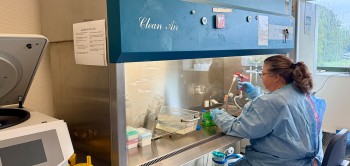
“Working with biological material must always be done safely, whether you are working with blood from humans or from monkeys”, says tuberculosis researcher Claudia. “That is why we often work in laminar flow cabinets in the laboratory, which protect both my research and myself.”
Tuberculosis is still the deadliest infectious disease worldwide. It is an important area of research at the BPRC. “What we see is that the current vaccine works particularly well against tuberculous meningitis. This is a serious form of tuberculosis in which the infection affects the brain or the membranes surrounding it, and it usually occurs at a young age”, says Claudia.
However, its effectiveness decreases later in life. The level of protection also varies considerably between individuals, from 80 per cent in one person to just 20 per cent in another. “That is why we want to investigate whether new vaccines work better or whether revaccination after a certain period could be an option.”
“My role in this is to investigate how the body responds to tuberculosis vaccination”, she explains. To do this, she studies white blood cells from the blood of monkeys. “This allows me to see whether a vaccine triggers an immune response after the monkeys have been vaccinated. Because we want to know whether the vaccine actually protects against tuberculosis, we also study the animal’s immune response after infection.”
‘It protects my research and myself’
Safety is essential when studying these white blood cells. “We have to protect ourselves against biological material, whether it comes from a monkey or a human. Human blood can also contain viruses.”
By working in a laminar flow cabinet, the research can be carried out safely. “It is a type of cabinet where only your hands go inside, so the cabinet protects both my research and myself”, Claudia explains. “It prevents me from contaminating my research, while also protecting me from the material I am working with.”
“This is because the air inside the cabinet flows in a controlled way. The air is extracted and then passes through a HEPA filter, where it is purified.”
Small things can cause disruption
Working properly in a safety cabinet also requires care from the researcher. “It is important to work calmly because movements can disrupt the airflow.” The objects placed inside the cabinet can also have an effect. “For example, if we put a container inside the cabinet, it can block the airflow. That is why we place such a container on small feet. This allows the air to flow underneath it and continue towards the filter.”
Safety cabinets are therefore an important part of research at the BPRC. They help researchers work safely with biological material and help keep research materials free from contamination. But a safety cabinet alone is not enough. How the researcher works with it is just as important.
Experience is passed on
“Everyone has to be properly trained”, Claudia says. “You need to achieve a certain level of competence to work at this level. It is also about experience. We have to train each other.”
The safety cabinet Claudia works at has been used for research at the BPRC since 1995. “It supports our research, but you always have to remain vigilant yourself.”
#BakerLaminarFlow