Transparency as the foundation for better science
Researcher Kari-Pekka Skarp explains why methods papers are essential for reliable science. By documenting every step of an experiment in detail, other researchers can reproduce and build on the findings. In this way, laboratory models and open science help accelerate the development of new treatments.
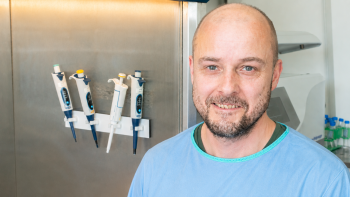
“Seeing is believing,” says researcher Kari-Pekka Skarp. “With a microscope, you can do more than just observe cells. You can also see how they function.” To enable others to share, evaluate, and verify these insights, it is essentialto describe exactly how the research was conducted. Only when every step is documented carefully can other researchers replicate the experiment. “That’s what makes writing a methods paper so important.”
For researchers, it is extremely important that they can reproduce research results. “They need to see exactly what we did, so that they can repeat the research themselves.” That is why Kari-Pekka wrote a methods article about research he previously carried out together with BPRC colleague and head of department Magdalena Lorenowicz.
“In Magdalena’s article, we showed how a special type of stem cell can save children's lives by helping to repair damage to the intestines after chemotherapy or radiation therapy,” says Kari-Pekka. “But a scientific finding only becomes truly valuable when other researchers can obtain the same results. That is why this methods article shows, step by step, how we carried out the research, so that other research groups can reproduce it and build on it.”
From flat cells to mini-organs
Before a new treatment can help patients, it first has to be clear whether it is safe and effective. “You cannot simply investigate that in humans,” Kari-Pekka explains. “That is why researchers use laboratory models in which human cells are grown. This allows them to study how a disease develops and whether a potential therapy works.”
Traditionally, cells are often cultured as a thin layer on a Petri dish. Although this provides a great deal of information, such a two-dimensional model resembles the human body only to a limited extent.
“We are not two-dimensional beings,” says Kari-Pekka. “That is why we try to develop models that represent reality as accurately as possible.”
An important example of this is organoids. “Stem cells are cultured in a special gel, allowing them to develop into three-dimensional mini-organs,” Kari-Pekka explains. “These organoids resemble ‘real’ organs much more closely.”
Every step documented
Whereas a research article mainly describes the results, a methods article focuses entirely on how the research was carried out. “Every step is described in detail.”
According to him, this is an important part of reliable science. Researchers can adopt the method, verify whether they obtain the same results, and then use the model for their own research. If other research groups find the same outcomes, confidence that the results are correct increases. Only then can researchers further improve the method, apply it to other diseases, or use it as the basis for follow-up research.
Making research more accessible
To help fellow researchers even further, the method article by Kari-Pekka and colleagues contains more than just a description of the protocol. The data analysis is also fully worked out.
“We created an Excel file in which researchers can enter their own measurement data,” says Kari-Pekka. “The file then automatically performs the statistical analyses and immediately generates clear graphs.”
This not only makes the experiment easier to reproduce, but also makes processing the results easier. As a result, researchers can focus more quickly on their research and apply the method directly to their own data.
“A great discovery is only the beginning. It is only when other researchers can confirm it and build upon it that it can develop into new treatments.”