Behind the scenes at BPRC: from long covid to malaria research
A feature in the Reformatorisch Dagblad offers a behind-the-scenes look at BPRC, from animal care to research on long COVID and malaria. It shows how animal models and animal-free innovations work together to advance scientific understanding and the development of new treatments.
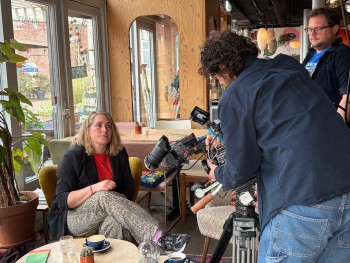
From rhesus monkeys playing with cardboard boxes to researchers using PET-CT scans to investigate the causes of long covid. A reporter from the Reformatorisch Dagblad recently visited BPRC and got a look behind the scenes of the research, animal care, and the people who work there.
The newspaper report begins with the rhesus monkeys living on our premises. Head of the monkey colony Annet Louwerse shows how animal welfare receives daily attention. Old fire hoses hang in the enclosures as climbing routes, there are swimming pools, and the animals are regularly provided with new forms of enrichment.
“You don’t want them to become bored,” Annet says in the article. That is why the animals are given cardboard boxes, old books, and food puzzles, among other things. Treats are also regularly hidden among paper shreds so that the animals keep searching and exploring actively.
Open about our research
Director Merel Langelaar is also featured extensively in the article. She talks about the research being conducted into infectious diseases such as covid, influenza, malaria, and tuberculosis, as well as complex brain disorders including Parkinson’s disease and Alzheimer’s disease.
She also discusses the public debate surrounding animal experiments and the importance of being open about the research we conduct. “People have the right to express their opinions,” she says about demonstrations at the centre. “We invite people to come and see for themselves and are happy to explain why we work with animals.”
At the same time, Merel emphasizes that BPRC is investing heavily in animal-free innovations. According to her, animals are still necessary for some complex research questions. “Ultimately, we need laboratory animals to prove whether a medicine works.”
Better understanding long covid
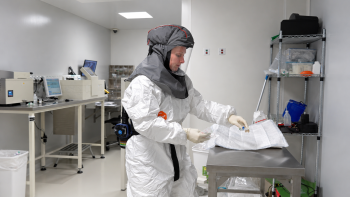
From the monkey enclosures, the report takes the reader to one of the research buildings, where imaging specialist Marieke Stammes works, among other things, on research into long covid and malaria. In the long covid studies, she sees that some animals show long-lasting changes after a coronavirus infection. Abnormalities are found in, among other organs, the heart and the brain.
“We see increased activation of the immune system and neurodegeneration there,” Stammes says about the findings in the brain. She also sees indications that coronavirus infection may have long-term effects on other organs. “I do not rule out the possibility that coronavirus increases the risk of brain disorders such as Parkinson’s and Alzheimer’s disease in the long term.”
By using PET-CT scans, researchers can visualize processes in the body that are often difficult or impossible to study directly in humans. This provides important insights into the possible causes of long-lasting symptoms following an infection.
Searching for hidden malaria parasites
PET-CT scans are also being used in malaria research. Innovative imaging techniques are used to visualize dormant malaria parasites in the liver.
“Malaria can, in principle, be treated effectively,” she explains. “But the dormant parasites remain in the liver.” By detecting these parasites, researchers hope to better understand where they are located and how future treatments can be made more effective.
The story also shows how different research methods complement one another. Within BPRC, extensive use is made of organoids, computer models, and other animal-free innovations. Nevertheless, there are research questions for which a complete living organism remains necessary.
Broad research
According to Stammes, the strong similarity between humans and monkeys plays an important role. “We want to translate our findings to humans, and monkeys are the best model for that. These animals allow us to learn things that cannot, or can hardly, be investigated in humans.”
The article in the Reformatorisch Dagblad shows how broad the research at BPRC is. From animal caretakers working every day to ensure the welfare of the monkeys to researchers seeking answers to questions about long covid, malaria, and other serious diseases.
At the same time, the report shows how different research methods complement one another. Wherever possible, researchers use animal-free innovations such as organoids and computer models. For some complex research questions, animal models are still needed. Together, these methods contribute to a better understanding of diseases and to the development of new vaccines, medicines, and treatments.