BPRC in Jekel's quest for eternal life
BPRC neuroscientist Jinte Middeldorp appears in Jekels jacht naar het eeuwige leven to explain research into ageing and the effects of young blood on the body. The programme highlights how fundamental research contributes to longer and healthier lives.
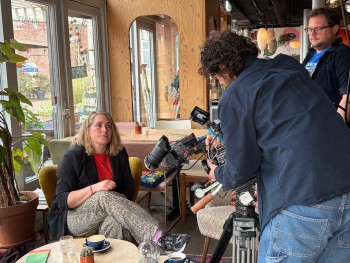
NPO 2 will broadcast an episode of Jekel's quest for eternal life on Thursday, June 4 at 8:30 PM, in which neuroscientist Jinte Middeldorp talks about the influence of blood on the ageing process.
In the programme, Diederik Jekel and Catalina Mosquera Rosas embark on a scientific quest to slow down ageing. The series of episodes shows how research can contribute to a longer and healthier life.
In the series, Diederik and Catalina speak with various researchers, including Jinte Middeldorp, head of the department of neurobiology and ageing. While she was still working in the United States, she investigated the effect of administering ‘young’ mouse blood to older mice.
Effects of blood on an older mouse
"When old mice received young blood, we saw, among other things, that the brain was once again able to form new neural connections," says Jinte.
To investigate this, a young mouse and an old mouse were surgically connected, allowing them to share the same blood circulation. Researchers were then able to study the effects that factors from the young blood had on the body of the older mouse.
Other research groups have shown that not only the brain, but also organs such as muscles and the liver, can exhibit positive effects. It is possible for organs to rejuvenate because they are plastic. "There are substances in the blood that are beneficial in young blood and harmful in old blood; these substances are then replaced by the young blood."
Although much research is still needed, Jinte sees possibilities for the future. "I think we can slow down ageing and go back a few years and live a number of years healthier than we do now."
The role of stem cells
Another important topic in the search for a longer and healthier life is stem cells. Stem cells are special cells that can develop into different types of body cells.
"Stem cells are cells in our body that can still become all cell types," explains another researcher. "We can take skin cells or blood cells and add substances; these substances are called genes. We then introduce these genes into the cells and can ensure that the skin cells return to their factory settings."
Although this technique is promising, scientists do not yet fully understand how they can grow these cells into fully mature and functional tissues. More knowledge is needed about the processes that control cell development.
Will we soon be printing our organs?
In his laboratory, researcher Ricardo Levato is working on developing organs and organ parts using bioprinters.
This technology resembles the well-known 3D printer, but does not use plastic as a building material. Instead, living cells are used to build biological tissue.
"Creating a fully functional organ remains a major challenge," explains Levato. "But it is an important goal for researchers within this field."
Researchers hope that this technique can contribute to new treatments in the future and possibly even help solve shortages of donor organs.
A digital version of yourself
The episode also explores a more futuristic question: can memories, thoughts and personality ever be digitally recorded? To answer that question, more knowledge is needed about how the brain works. Researchers at Radboudumc demonstrate how they are using MRI techniques to better understand how visual information is processed into brain activity.
These insights may ultimately contribute to new treatments for people with neurological disorders or brain damage. In addition, scientists are investigating how artificial intelligence can be trained on personal data so that a system can communicate in a way that resembles a specific person. Although this technology is still under development, it raises interesting questions about identity, memories and the future of humans and technology.
The episode of Jekel's quest for eternal life can be viewed on NPO Start from June 4 onwards (in Dutch). The big question of whether we will ever truly be able to slow down ageing remains unanswered for now. But every new discovery brings researchers one step closer to a future in which people not only live longer, but above all remain healthy for longer.