Susan Ott Presents her tool to an international scientific audience
Researchers from around the world will gather at Yale University in June for an international meeting focused on antibodies and immune receptors. Susan Ott from BPRC will also be attending. Not only was her scientific abstract selected for both an oral presentation and a poster, she has also been invited to deliver an extensive tutorial on the software tool she developed together with colleagues.
"To be honest, I never really expected to be standing there myself," Susan says with a broad smile. "All the leading experts in the field will be there. It's very special to have the opportunity to present both my research and our tool."
VDJ-Insights
Susan is a researcher at BPRC and, together with colleagues, developed a software tool called VDJ-Insights. The tool enables researchers to analyze complex B-cell and T-cell receptor regions in DNA much faster and more accurately. Tasks that previously required weeks of manual work can now be completed in approximately fifteen minutes, she explains.
During an interactive session, Susan will guide researchers step by step through the software and demonstrate how they can apply it in their own research. The tutorial has a strong practical focus. Participants will not only learn about the capabilities of the software but will also gain hands-on experience using it themselves. Susan will also compare VDJ-Insights with existing analysis tools that are widely used around the world.
"I want to show people what the different tools can do. VDJ-Insights provides rapid insight into genetic variation within the immune system," Susan explains. "That helps researchers better understand why individuals respond differently to infections or treatments."
A Small, Specialized Community Where Everyone Knows Each Other
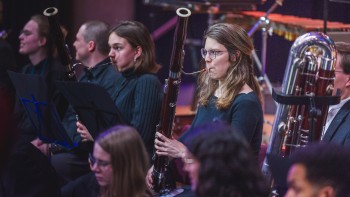
Susan's colleagues know that her workdays often continue long after everyone else has gone home. It is not uncommon to see her leaving the building late in the evening with a bassoon case on her back. After a day of programming, analyzing, and conducting research, she heads off to her music lessons.
The combination of science and music suits her well. Susan studied in Groningen, Wageningen, and Sweden, and combines bioinformatics, immunology, and genetics in her research. She also plays the bassoon, an instrument that, much like her research field, is highly specialized.
"In the Netherlands, the bassoon is one of the rarest instruments. It's a small world where many people know each other,"she says. "My research field sometimes feels the same. Worldwide, there are relatively few researchers working on the complex B-cell and T-cell receptor regions that I study. But when you attend an international conference, you suddenly meet many people who share exactly the same fascination."
Valuable International Recognition
For BPRC, the invitation is also an important form of international recognition. The fact that Susan has been invited not only to present her research but also to teach a tutorial for international colleagues highlights the growing visibility and impact of the institute's research.
And, just as in music, success is ultimately not only about technical skill but also about telling a compelling story. Susan is therefore preparing her presentation with great care—not only scientifically, but also personally.
"I want to help people understand why this research matters," she says. "And hopefully inspire them to start using the tool themselves."
Photo: Kang Li
